
How to Ensure AI Data Governance for Enterprises


Enterprise AI projects rarely fail because of the model. They fail because sensitive data enters training sets and RAG pipelines faster than teams can classify or control it. AI data governance closes that gap without locking data away from the use case.
When enterprise AI projects fail, the model usually gets the blame. The real problem sits one layer down, in the data. Sensitive information flows into training sets and RAG pipelines faster than teams can classify, trace, or control it, and that gap is where projects stall. Gartner projects that through 2026, organizations will abandon 60% of AI projects that lack AI-ready data. It also found that 63% of organizations either lack the right data management practices for AI or aren't sure whether they have them.
There's a common assumption that sensitive data forces a choice: lock it down and starve the AI use case, or let it flow and accept the leakage, bias, and broken audit trails that come with it. That assumption is wrong. The companies putting AI into production govern their data at the moments it enters and leaves the system, which keeps it usable and controlled at the same time.
AI data governance is how they do it, and this article covers what it involves and how to put it in place.
What is AI data governance?
AI data governance is the set of policies, controls, and accountability structures that manage data across the full AI lifecycle, from collection through logging. Traditional data governance assumed deterministic queries against static datasets with known schemas.
AI breaks those assumptions: models memorize training data, RAG pipelines pull from live systems at query time, and outputs are probabilistic.
Common AI failure modes begin with data governance gaps. This includes:
- Unvalidated retrieval and training data increase hallucination risk.
- Unexamined datasets increase bias risk.
- Model poisoning exploits missing provenance controls.
- Data leaks and prompt injection exploit missing classification and access controls
AI governance fails at the same place security programs do: the data layer. Without the ability to classify, control, and audit what enters training and inference, bias, leakage, and provenance gaps are inherited by default.
The regulatory landscape for AI data governance
Each major framework now creates a concrete, dated AI obligation rather than a general privacy principle:
Those rules all point to the same control plane: provenance on data used for training, classification before data enters a model pipeline, and auditability when a regulator asks what was processed, when, and under which policy. In practice, that means governance has to start at the data layer, not after the model is already in production.
How to ensure AI data governance for enterprises
Governing AI data requires four sequential steps: classify sensitive data, enforce access policies, control what enters the pipeline, and monitor model outputs.
1. Discover and classify sensitive data across structured and unstructured sources
Governance starts with knowing where sensitive data lives. That means inventorying personally identifiable information (PII), PHI, PCI, and proprietary data not only in databases and SaaS applications, but in the unstructured content that feeds modern AI: documents, support tickets, chat logs, images, and audio. Sensitive data in free text and files is where classification most often falls short, and it is exactly what RAG pipelines and AI agents pull from at runtime.
Automated classification should run before any dataset reaches a training set, a RAG index, or an agent's context window, and it should cover structured fields and unstructured content in the same pass. Detecting and labeling sensitive entities across text, files, images, and audio closes the gap that field-level scanning alone leaves open.
Classification also depends on lineage. Recording where each dataset came from and how it was transformed is what makes governance auditable, and NIST AI RMF GOVERN 4.2 treats that documentation of provenance, transformations, and dependencies as a core accountability rather than an audit afterthought.
2. Define policies and access controls
Policies govern anything only when they are enforceable rules rather than PDF documents. A policy stating that marketing cannot access full card numbers matters only when an access-control system evaluates it on every request, including requests an agent makes on a person's behalf.

Policy-Based Access Control (PBAC) evaluates centrally managed policies at request time against current attributes, which is what governs an agent requester correctly: every call is checked in real time, with no permissions carried over from a prior session. Enforcement belongs at the column and row level, and authorization checks belong outside the model rather than trusting the LLM to police itself.
3. Prevent sensitive data leaks into pipelines and outputs
The most durable way to keep sensitive data out of pipelines and outputs is to isolate and transform it at a single control point, rather than police it everywhere it travels. Sensitive values move into one governed location and get replaced with tokens throughout the systems that use them.
Every pipeline, model, and agent then runs on tokenized data, while the sensitive originals stay in one place that can be governed, audited, and access-controlled. This turns data governance from a set of scattered rules into a single architectural control.
Before any dataset enters that flow, its legal basis has to hold. Training on personal data without one is exactly what regulators have penalized, so consent and purpose need verifying up front and re-checking whenever sources or processing purposes change.
Tokenizing at the ingestion boundary keeps records usable without exposing them. A pipeline that blocks every record containing PII breaks the use case; one that tokenizes the sensitive fields keeps the record intact while the actual values stay isolated. Context-preserving tokenization lets a model tell one patient from another without ever seeing a real name. On the output side, policy-controlled rehydration decides per requester which values are re-identified, so only authorized users see data in its original form.
Keeping sensitive data out of training has a secondary payoff: models working from clean, consistent tokens are less prone to fabricating or misattributing sensitive details.
4. Add oversight for model behavior
Fairness and bias evaluation belongs in the standard model-development process, not as a one-time check: scheduled bias tests run on a cadence, and the artifacts are retained as evidence.
Explainability tools help but are not proof. SHAP attributes predictions using Shapley values, and LIME fits local surrogate models around individual predictions; both can be fooled by adversarially crafted classifiers, LIME more easily than SHAP. They are best treated as supporting evidence rather than guarantees.
High-risk decisions need a human in the loop. Requiring human approval for privileged operations is a design requirement for any high-risk system, not an afterthought.
How Skyflow enables AI data governance
Skyflow is the Runtime Data Control Platform for Agentic AI. It secures the flow of sensitive data across datastores, models, and agents. It keeps PII, PCI, and PHI governed and isolated while applications operate on protected data instead of actual values.
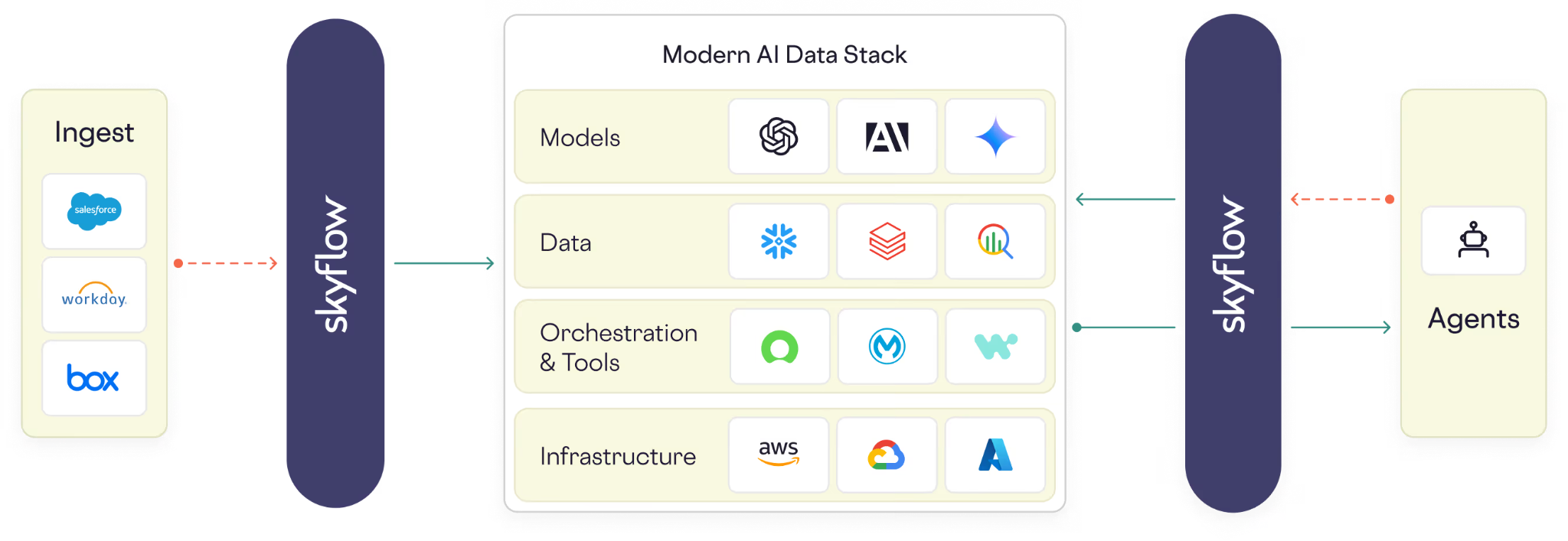
For AI specifically, Skyflow acts as the runtime enforcement layer for the practices above. Sensitive data stays isolated and never reaches a training set, prompt, or log in raw form, while applications, models, and agents work with tokens. Policy-based access control (PBAC) at the column and row level then decides what each requester sees at access time.
Skyflow applies the same control path at every runtime boundary:
- The Detect API (deidentifyText, reidentifyText, deidentifyFile) finds and de-identifies sensitive data in both structured records and unstructured text, audio, images, and PDFs before it reaches training or inference.
- Context-preserving tokenization keeps entities distinct, so models stay accurate while raw values stay isolated.
- PBAC-controlled rehydration applies per-user policy: an auditor sees plaintext, a support agent sees masked values, a basic user sees neither, all from the same response.
- Every access is logged with field-level policy context and streamed to storage, which supports Article 12-style logging evidence.
- For agentic workloads, the Skyflow MCP server routes sensitive data through Skyflow automatically for agents using the Model Context Protocol.
- The same API surface runs across three deployment models: multi-tenant SaaS, Virtual Private Skyflow in a dedicated VPC, and Bring Your Own Cloud for full residency control.
Treating data control as infrastructure gives teams a governed path to real customer data, which is what stalled pilots need to reach production. Building that path in-house turns tokenization, PBAC, de-identification, and audit logging into separate projects, and the result is slow pilots, inconsistent controls, and an architecture that buckles under production traffic.
Skyflow centralizes those controls in one place and prices by protected data subject rather than by API call, so costs stay predictable as AI inference volume scales. Engineering teams evaluating Skyflow for a production deployment or scoping a migration can get a demo to walk through their architecture and compliance requirements directly.
Frequently Asked Questions about AI data governance
How does AI data governance differ from traditional data governance?
Traditional governance manages static datasets with known schemas and deterministic access. AI data governance extends those controls across the AI lifecycle, where models memorize inputs and outputs are probabilistic, so classification, lineage, and access decisions occur continuously at runtime.
Who should own AI data governance?
Ownership is layered: data owners approve use, data stewards enforce quality and classification rules, a governance committee sets policy, and an AI model owner is accountable for training-data documentation, bias evaluations, and drift response. The CIO or CDO typically holds the platform mandate because they alone see the full data topology.
Which regulations apply to enterprise AI systems?
GDPR governs any personal data extractable from a model; the EU AI Act adds data governance duties for high-risk systems; CCPA/CPRA adds ADMT notice and opt-out rules; and HIPAA governs PHI in any AI workflow.
How is regulated data kept out of training datasets and outputs?
Preventing personally identifiable information (PII), protected health information (PHI), and proprietary records from leaking into AI pipelines requires action on both the input and output sides.
On the input side, classify and discover sensitive data before ingestion. Verify the legal basis and consent for training use. Then de-identify or tokenize at the pipeline boundary so raw values never reach the model. Entity- and context-preserving tokenization keeps records structurally usable while reducing hallucination risk.
On the output side, policy-controlled rehydration determines per requester which values are re-identified, with least-privilege access enforced by policy so that only authorized users ever see sensitive data in its original form.